Showing posts with label Religion. Show all posts

Monday, October 11, 2010

Hofstede and Confucius


In the cultural dimensions of the United States we can see that individualism is incredibly high, with the power distance index considerably moderate, and long term orientation somewhat low.


In China, individualism is barely on the chart, showing that the Chinese place much more importance on collectivism. This fits in with the Confucian virtue of rén, which is the balance between individual interests and communal interests.
The long term orientation dimension in China is astronomically high, meaning that this is a society that is willing to wait out trials and obstacles.
The high power distance index shows a high level of inequality of power and wealth within the society. This condition is not necessarily forced upon the population, but rather accepted by the society as their cultural heritage. This would coincide with the importance placed on respect and duty to relationships in Confucianism. For example, an employee exhibiting xo would have a strong sense of duty toward his boss, and therefore may be unconcerned if there is a considerable gap in power between himself and his employer.

Atheist, but Influenced by Confucius


China’s religion is officially designated as Atheist by the State, although the concepts and teachings of the ancient Chinese philosopher Confucius (500BC) are woven into the society at large.


http://www.geert-hofstede.com/hofstede_china.shtml

Sunday, October 10, 2010

Some Confucian Virtues

Rén (Chinese: ) - Although the precise meaning of rén is not easily explained, it can be described as a balance between individual interests and communal interests. It is sometimes translated as "benevolence" or "humanity." Rén can only be applied as a virtue within the context of relationships, and is sometimes compared to the "Golden Rule" of Western thought: Treat others the way you would like to be treated.

(Chinese: ) - is the concept of ritual, and was expressed in the form of proper ceremonies, music, etiquette and rites. This virtue of ritual in Confucianism serves mostly as an exterior gauge for measuring moral excellence.

Yi (Chinese: ) - Yi is the virtue of righteousness or appropriateness, which can be understood as the act of following lǐ, or of following customs or norms.


Xiào (Chinese: ) - Xo is the virtue of filial piety, meaning loyalty and duty to one's family. Xiào can also be duty or loyalty to any relationship. Confucius discusses five main relationships, ruler/subject, parent/child, husband/wife, elder sibling/younger sibling, and friend/friend.

This information was gathered from: http://faculty.plattsburgh.edu/kurtis.hagen/keyterms_yi.html and Striking a Balance by Michael C. Brannigan

Steve Jobs vs. Confucius

This video contrasts the Western ideal of individualism with the Chinese ideal of harmony.

Friday, October 8, 2010

Confucianism Overview


Some say Confucianism is not a religion, since there are no Confucian deities and no teachings about the afterlife. Confucius himself was a staunch supporter of ritual, however, and for many centuries there were state rituals associated with Confucianism. Most importantly, the Confucian tradition was instrumental in shaping Chinese social relationships and moral thought. Thus even without deities and a vision of salvation, Confucianism plays much the same role as religion does in other cultural contexts. The founder of Confucianism was Kong Qiu (K'ung Ch'iu), who was born around 552 B.C.E. in the small state of Lu and died in 479 B.C.E. The Latinized name Confucius, based on the honorific title Kong Fuzi (K'ung Fu-tzu), was created by sixteenth century Jesuit missionaries in China. Confucius was not particularly famous during his lifetime, and even considered himself to be a failure. He longed to be the advisor to a powerful ruler, and he believed that such a ruler, with the right advice, could bring about an ideal world. The earliest records from his students indicate that he did not provide many moral precepts; rather he taught an attitude towards one's fellow humans of respect, particularly respect for one's parents, teachers, and elders. He also encouraged his students to learn from everyone they encountered and to honor others' cultural norms. Later, his teachings would be translated by authoritarian political philosophers into strict guidelines, and for much of Chinese history Confucianism would be associated with an immutable hierarchy of authority and unquestioning obedience.


This info was gathered from http://www.patheos.com/Library/Confucianism

The Origins of Buddhism

The Origins of Buddhism


http://sites.asiasociety.org/education/VISIBLE_TRACES/curriculum/pdf/CBEessay.pdf

Taoism - Daoism

  • Taoist  - Yin Yang Symbol
    • Represents opposite forces is a reminder to try and balance these forces.
  • Dao de jing - "The book of the way and its power."
  • Harmony with the way to achieve balance 
  • Lao zi "Old Master"


"Be still like a mountain and flow like a great river." Lao Tse.

http://www.religioustolerance.org/taoism.htm

http://asiasociety.org/countries-history/religions-philosophies/chinese-belief-systems

Buddhism

Timeline of Buddhism in China
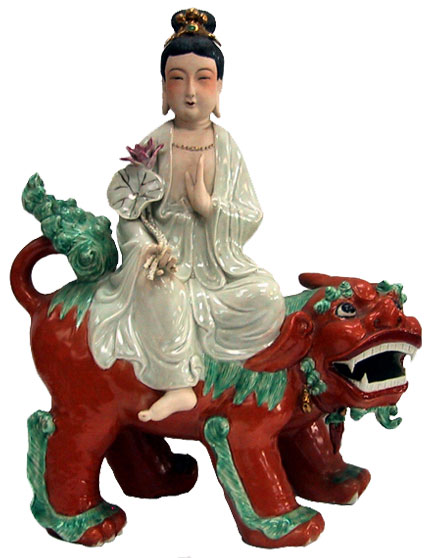
Wen Shu Shih-Li P'usa or Manjushri Bodhisattva

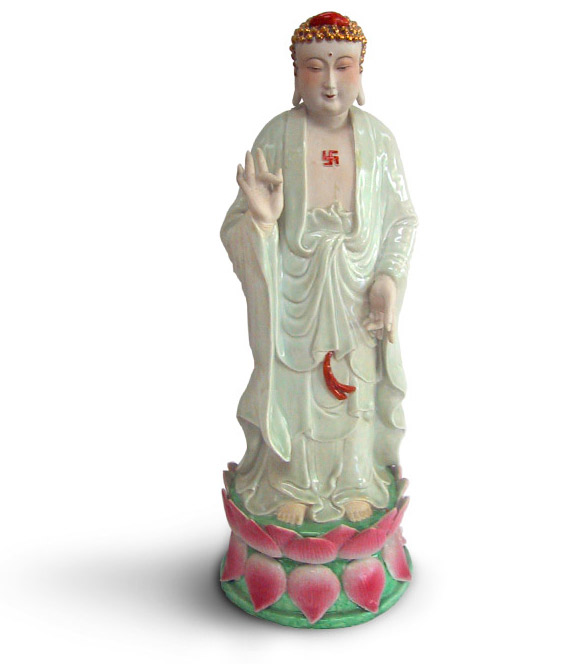
AMITABHA: Buddha of Boundless Light of the Western Paradise

 Chinese Buddhas

Buddhism in China

  • Dominant in China form is the Mahayana "The Greater Vehicle"
  • Salvation and compassion
  • Bodhisattvas -" enlightened beings"delay Nirvana to actively help others.
  • Bodhisattva Guanyin 
    • aids the suffering of the world
    • devotional figure for Chinese Buddhists and Daoists
  • Four Noble truths
    • Suffering
    • Desire and attachment led to suffering
    • End to suffering is possible
    • There is a path - Eightfold way
  • Noble Eightfold way
    • Right view
    • Right intention
    • Right speech
    • Right action
    • Right livelihood
    • Right effort
    • Right mindfulness
    • Right concentration

The Spread of Buddhism


http://www.historywiz.com/galleries/buddhismspread.htm

Buddha