Friday, October 8, 2010

Imports - Soybeans

In an article written by John Baize, a specialist on international soybean trade, talks about China's growing impact on the soybean market in the world. He explains this in an article found here written in Nov. 2009:

China was originally self-sufficient in soybean however today China has reached to be the by far the world's largest importer of soybeans and soybean oil. It's expected that this year China could import about 52% of all the soybeans expected to be imports by all the nations in the world.

Today China is the largest market for U.S. soybean producers.

http://www.unitedsoybean.org/community.aspx?bid=3499451022295723697


The Origins of Buddhism

The Origins of Buddhism


http://sites.asiasociety.org/education/VISIBLE_TRACES/curriculum/pdf/CBEessay.pdf

Taoism - Daoism

  • Taoist  - Yin Yang Symbol
    • Represents opposite forces is a reminder to try and balance these forces.
  • Dao de jing - "The book of the way and its power."
  • Harmony with the way to achieve balance 
  • Lao zi "Old Master"


"Be still like a mountain and flow like a great river." Lao Tse.

http://www.religioustolerance.org/taoism.htm

http://asiasociety.org/countries-history/religions-philosophies/chinese-belief-systems

Facts of Chinese Language


Facts of Chinese Language

The Chinese writing system is one of the oldest known written languages, some ancient Chinese writing date back to over 4,000 years ago. The written Chinese writing systems uses a logographic system (a series of symbols that represent a complete word or a phrase). The system consists a large Chinese symbols known as chracters.
The Chinese writing system is unique in many respects. There are two main languages in China: Mandarin Chinese and Cantoese Chinese. From these two languages sprouted many different dalects. The Chinese writing system was the one unifying element that brought all these languages into one standard written language. Spoken Chinese has changed remarkbly over the centuries, while Chinese writing has changed little from the ancient Chinese.
There are four distinct periods of chinese writing.


Jia-gu wen (Oracle Bone) 1500-1000 B.C. It is the earliest Chinese symblos that were etched onto tuttle shells and animals bones.

Da zhuan (Greater Seal). 1100-700 B.C. This script appeared mostly on cast bronze vessels.

Xiao zhuan (Lesser Seal). This version of Chiese caligraphy was the predecessor for the more stremlined version of modern writing. The lesser seal script was originally found on bamboo scrollsm, but also you can find on silk writings and landscape paintings.

Lis shu (Clerkly Sript). This is the modern Chinese writing system. This set of symbols became popular in part for tis flowing script that was fast and efficent to write.


  • (For more details, see link)

    1950, China established the new simplified writing system. However, traditional writing system is still being used in Hongkong, Taiwan, Macau.


    The Chinese symbols are beautifully drawn using caligraphy. Traditionally, the Chinese characters are written in columns. They are read from top to bottom and from right to left. In fact, Hanzi (Chinese characters) numbers more than 50,000 symbols. The People's Republic of Chinea introduced a program to simplify the language into a set of commonly used characters. The current writing system uses approximately 6,000 of these characters. Current chinese writing includes two main methods of writing symbols. the Wenyan method which uses classical chinese symbols, and the Baihua method which includes vemacular chinese symbols.


    Spoken chinese: All Varieties of Chinese belong to the Sino-Tibetan family of languages and each one has its own dialects and sub-dialects. In all over 1.3 billion people speak on or more varieties of Chinese. All Varieties of Chinese are tonal. This means that each syllable can have number of different meanings depending on the intonation with which it is pronouced. For example Madarin has 4 tones, Cantonese has between 6 and 9 (it depends who you ask) and Taiwanese has 7 tones.

    (See link to learn areas distribution)

    More Language Differences:English is almost always written from left to right. However, Chinese can be written from top to bottom, right to left, as well as left to right. English has a significant number of polysyllabic words, one Chinese character is never longer than one syllable. The majority of Chinese words are made up of two characters, but Chinese words are not commonly tri- or polysyllabic. Chinese and English differ in terms of dialects, orthography, phonetics, grammar, and in many other important ways.

    Links:

    http://www.languagehelpers.com/languagefacts/chinese.html

    http://www.ancientscripts.com/chinese.html


    Food by Regions of China


    Chinese food can be divided into four different regions; Southern, Northern, Eastern and Western.

    Southern Region ( Cantonese)
    - High production of rice and pork but also use a large variety of meats and vegetables
    - lightly flavored; stir-fry (Fried Rice)
    - sweet and sour dishes
    - foods in this region are most well known to Americans

    Northern Region (Mandarin):
    - Temperatrue crops: wheat, fruit and corn
    - Wheat is most popular because of the severe weather rice is hard to produce.
    - Wheat is made into noodles, pancakes and dumplings.
    - Use alot of flavored sauces such as onion, garlic, cabbage, bean pastes, dark soy sauce and oyster
    - Dishes such as Peking Duck, Mongolian Hot Pot and Mongolian Beef
    - affected by water scarcity

    Western Region (Szechwan):
    - famous for use of chili peppers in variety of dishes
    - most popular dishes: smoked chicken, hot and sour soup, twice cooked pork, barbeque mutton and beefsteak.
    - Spices inclue five-spice powder and szechwan pepper.

    Eastern Region (Shanghai):
    - Rice and Wheat noodles is most popular
    - Has many river and waterways so seafood is a very large part
    - Cooking style is delicate and refined
    - Seafood includes shrimp, fish, crab, crayfish, lobsters and oysters
    - Also known for sweet and savory pastries

    Buddhism

    Timeline of Buddhism in China
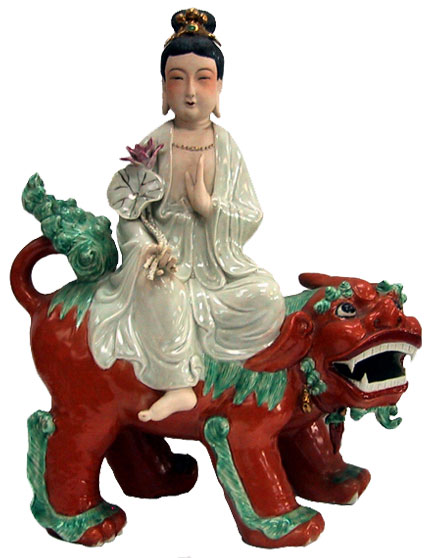
    Wen Shu Shih-Li P'usa or Manjushri Bodhisattva

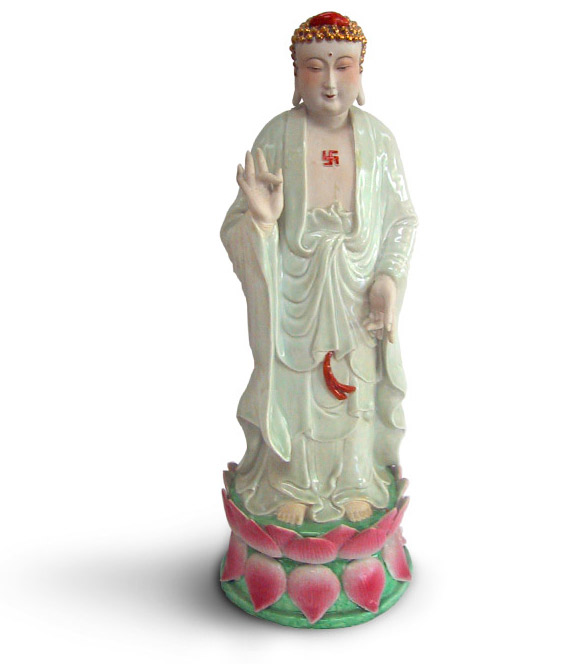
    AMITABHA: Buddha of Boundless Light of the Western Paradise

     Chinese Buddhas

    Buddhism in China

    • Dominant in China form is the Mahayana "The Greater Vehicle"
    • Salvation and compassion
    • Bodhisattvas -" enlightened beings"delay Nirvana to actively help others.
    • Bodhisattva Guanyin 
      • aids the suffering of the world
      • devotional figure for Chinese Buddhists and Daoists
    • Four Noble truths
      • Suffering
      • Desire and attachment led to suffering
      • End to suffering is possible
      • There is a path - Eightfold way
    • Noble Eightfold way
      • Right view
      • Right intention
      • Right speech
      • Right action
      • Right livelihood
      • Right effort
      • Right mindfulness
      • Right concentration

    The Spread of Buddhism


    http://www.historywiz.com/galleries/buddhismspread.htm